
AI / DATA SCIENCE / RESEARCH

CARDAAI, built to matter.

Creating things that work, teaching people how to build them, and making AI easier to reason about.

Explore my work Let’s talk →

Hi, I’m Charles. I build, teach & research AI.

Selected work / 03 cases

Three example
AI solutions

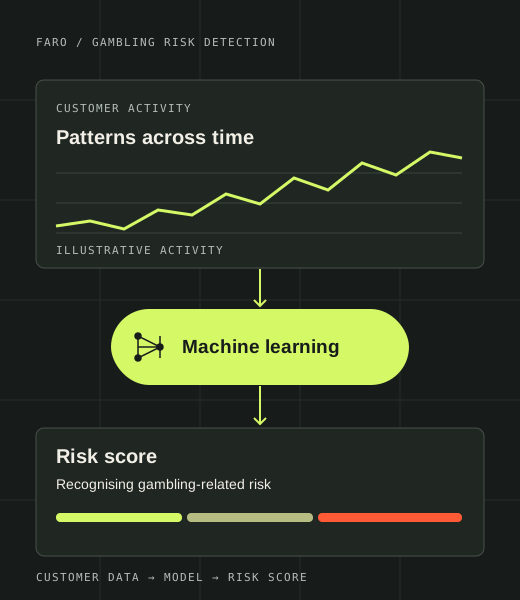
FARO: gambling activity data flows through a machine learning model to produce a risk score. The activity chart is illustrative.
FARO[1/3]

For this project, I ...

  • quit my job and joined Reinout Wiers at the University of Amsterdam as a PhD candidate,
  • pitched to ZonMw, which got the idea funded,
  • collected two years of all customer data from 13 licensees (hasn’t been done before),
  • trained a machine learning model that gives back a risk score.

On 18 Aug 2026, the resulting open-source tool was published by the Dutch Gambling Authority. It was featured on NOS, Trouw, BNR, multiple international media and discussed in Dutch parliament.
SPINE[2/3]
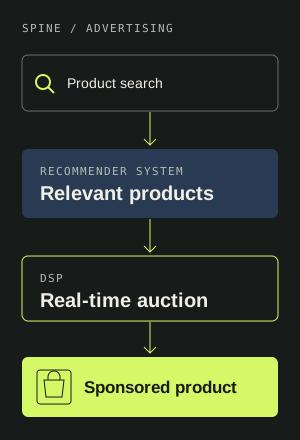
SPINE: product search, recommendations and a real-time advertising auction lead to a sponsored product.

I was asked to build the architecture of a Demand-Side Platform (DSP) in 2023 by Frans Vermeulen, who I thank for then recommending me for promotion into a manager role. I only wanted to do it if I was given the guarantee to do 50% coding on the side, which I had to request from the CTO at the time, which was Jurrie van Rooijen.

I started with two of my direct reports. After 1 year, 8 teams were working on this solution as its profit was over 100M EUR/year, of which 8M per year cost saving due to building in house solutions. It was a very cool problem, as it combined search solutions (NLP), recommender systems and auctioning logic. And it needed to be very fast.

After two years of management experience, I decided I was missing the coding too much, and I transferred into the role of Data Science Craft Lead for Shopping and Advertising, the largest domain of bol.

OSCAR[3/3]
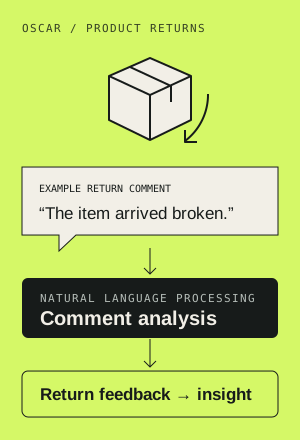
OSCAR: a returned parcel and an example customer comment feed into natural language analysis to extract insights from return feedback.

During a two-day hackathon, I created a natural language microservice (‘Oscar’) which evaluates comments of returned products, generating 400.000 EUR/year.

I like this project because it was super fun to create, and it signifies the power of being able to completely deploy a service on your own. Things don't always need to be complicated if you have the right tools and surroundings.

Not the most life-changing tool, but a fun example of how a hands-on innovation can be made with relative ease.

Formats

Workshops &
Masterclasses

Three ways to move from idea → decision → understanding.

01BUILD

Turn an idea into something that actually works.

Hands-on sessions for people who want to move beyond talking about AI. Start with a real problem, build something tangible and learn an approach you can reuse afterwards.

⌁

AI/DS Prototype

From a problem, how do we get to a solution?

↯

AI Sprints

How can we collaborate with AI as a team?

02DECIDE

Make better AI decisions without having to become an AI engineer.

Decision tools for finding and shaping the problems worth solving.

⊞

Creating an AI Impact Evaluation Chart

How can we identify the right problems to work on?

◇

AI Prototype Epic

How can we make sure that AI innovation is happening?

03UNDERSTAND

Understand what's real, what's hype and what is coming next.

A clearer view of what current AI can and cannot do.

≠

What AI can and cannot do.

A fun workshop where we deep dive into the limitations of LLM's

→

What is next?

A sparring session where we challenge ourselves

Not sure which format fits?

Tell me what you are trying to achieve. I'll suggest the format that makes most sense — or combine several into one session.

Start a conversation ↗

On stage

Inspirational
talks

I like talking about AI!

05 / Research

From research
to real life.

My research brings machine learning to a human problem: recognising gambling-related risk.

I joined Reinout Wiers at the University of Amsterdam as a PhD candidate and secured funding from ZonMw to develop the idea behind FARO.

13
gambling licensees
2 years
of customer data
Featured researchFARO

Understanding risk.
Making it actionable.

The data

Two years of customer data from 13 licensees brought together for the research.

The model

A machine learning model that uses customer data to return a gambling risk score.

Out in the world

The resulting open-source tool was published by the Dutch Gambling Authority on 18 August 2026.

Read the NOS coverage

Contact

charles@carda.nl